NetSuite is renowned for its comprehensive features and customization capabilities. Among these features is the ability to format numbers according to different regional standards, which is crucial for businesses operating globally. However, customizing number formats, particularly to non-standard regional formats like the Indian numbering system (e.g., 1,00,000.00 instead of 1,000,000.00), poses a unique challenge. In this blog, we will explore how number formatting works in NetSuite, and its limitations.
Number Formatting in ERP Systems
Number formatting is not just a cosmetic feature; it is integral to ensuring clarity and accuracy in financial reports, transactions, and analytics. Proper number formatting:
- Enhances readability for users accustomed to specific regional formats.
- Reduces the risk of misinterpretation of financial data.
- Ensures compliance with regional accounting practices.
Number Formatting Options in NetSuite
NetSuite offers various pre-configured number formatting options to accommodate different regional preferences. These options can be accessed and modified under the company settings:
- Company Settings:
- Navigate to Setup > Company > General Preferences.
- Here, you can set the default number format for your organization.
- User Preferences:
- Individual users can customize their own number format settings by going to Home > Set Preferences > Formatting.
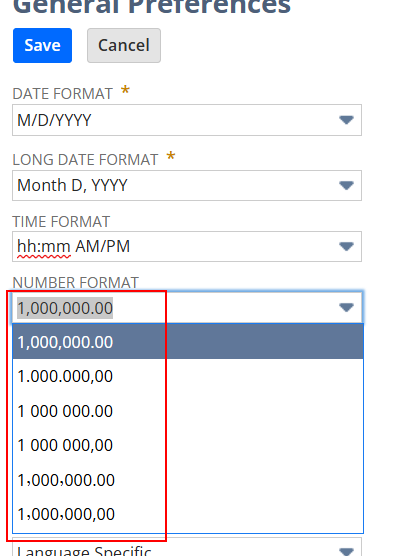
These settings allow users to choose from several standard number formats, typically those used in Western countries, such as:
- 1,000,000.00 (US)
- 1.000.000,00 (European)
- 1 000 000,00 (French)
The Challenge with Indian Number Formatting
The Indian numbering system is unique and follows a different pattern for grouping digits. Instead of grouping digits by thousands, it groups them by lakhs (hundreds of thousands). For instance:
- 1,00,000 instead of 100,000 (one hundred thousand)
- 10,00,000 instead of 1,000,000 (one million)
NetSuite does not natively support this format, posing a challenge for businesses in India or those dealing with Indian clients.