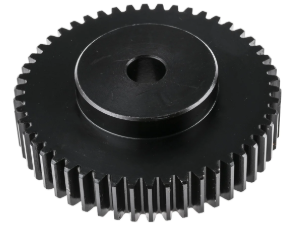
A spur gear is the most common type of gear, featuring straight teeth that are parallel to the axis of rotation. It is used to transmit power and motion between parallel shafts efficiently. Spur gears are known for their simplicity, high efficiency, and ability to handle high loads.
Key Features of Spur Gears:
- Straight Teeth – Aligned parallel to the gear’s axis, allowing smooth power transfer.
- Parallel Shafts – Designed to mesh with another spur gear on a parallel shaft.
- High Efficiency – Minimal energy loss due to their direct engagement.
- Cost-Effective – Simple manufacturing process makes them economical.
- Limited Speed – Best suited for moderate to low-speed applications to reduce noise and vibration.
Advantages:
✔ Simple design and easy to manufacture
✔ High power transmission efficiency
✔ Can handle large loads
✔ Minimal axial force (thrust force)
Disadvantages:
✖ Noisy at high speeds due to sudden tooth engagement
✖ Limited to parallel shaft applications
✖ Subject to wear and tear under heavy loads
Common Applications:
- Gearboxes
- Industrial machinery
- Clocks and watches
- Conveyor systems
- Automotive transmissions