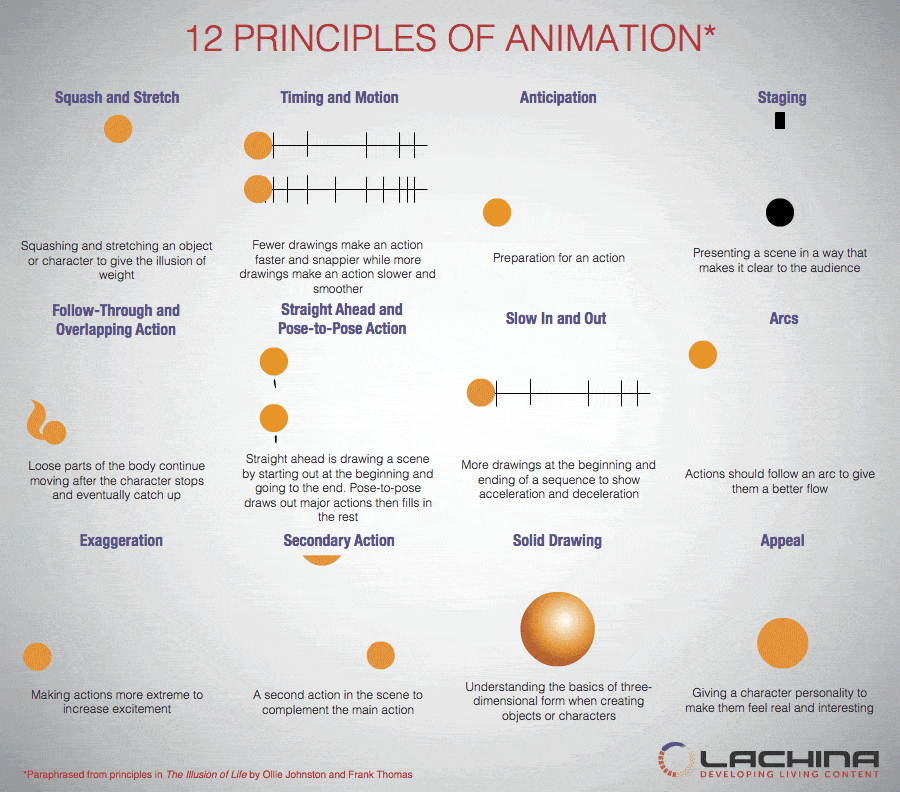
Animation is more than moving objects on a timeline—it is the art of giving digital creations soul, personality, and believable motion. Animation is far more than moving drawings or digital models—it is the art of bringing characters, objects, and worlds to life. 12 Principles of Animation is essential for creating believable, expressive, and appealing motion. These principles were developed by Disney animators Ollie Johnston and Frank Thomas and remain the foundation of good animation even today. These principles remain the backbone of modern animation, including VFX, games, and CGI films.
1. Squash and Stretch
This principle gives a sense of weight, gravity, and flexibility.
- A bouncing ball squashes when it hits the ground and stretches as it moves up.
- In characters, facial expressions and body movements use this principle to feel lively.
- It gives life and elasticity to animation.
- proper deformation controls to maintain realism.
2. Anticipation
Before an action, the character prepares for it.
- A person bends their knees before jumping.
- A golfer pulls back the club before swinging.
- It builds expectation and makes the action clear and realistic.
- Anticipation adds clarity and prevents actions from feeling sudden or robotic.
3. Staging
Staging is about presenting an idea clearly to the audience.
- Camera angles, lighting, and positioning guide the viewer’s attention.
- Only one idea should be clearly visible at a time.
- It ensures clarity and good visual storytelling.
- Good staging ensures the audience understands the action instantly.
4. Straight Ahead Action and Pose-to-Pose
These are two methods of animating.
- Straight Ahead: Animate frame by frame from start to end—great for fluid, unpredictable motion like fire or hair.
- Pose-to-Pose: Create key poses first, then fill in between—ideal for controlled character animation.
- Choosing the right method leads to better flow and structure.
- Ideal for character acting and planned shots
- Great for dynamic movements like fire, cloth, or chaotic scenes
5. Follow Through and Overlapping Action
Movement doesn’t stop all at once.
- When a character stops running, hair or clothes continue to move.
- Overlapping action means different body parts move at slightly different times.
- Adds realism and natural flow.
- Use simulation or manually animate secondary controls for better results.
6. Slow In and Slow Out
Objects accelerate and decelerate gradually.
- More frames at the beginning and end of an action, fewer in the middle.
- Makes motion smooth and natural.
- This is one of the easiest and most powerful principles to improve animation quality.
7. Arcs
Most natural movements follow curved paths.
- Arms, legs, heads, and objects rarely move in straight lines.
- Arcs make animation graceful and believable.
- Natural movements follow curved paths, not straight lines.
8. Secondary Action
A smaller action that supports the main action.
- A character walking while their arms swing naturally.
- A facial expression while someone talks.
- Adds depth and enhances storytelling.
- Secondary actions add personality and depth.
9. Timing
Timing controls the speed of the action.
- Fast timing = energy or urgency
- Slow timing = emotion, weight, or clarity
- Good timing defines personality and realism.
- Good timing communicates the story effectively.
10. Exaggeration
Enhancing an action or expression to make it clearer or more entertaining.
- A surprised character’s eyes becoming bigger
- A big leap exaggerated for comedic effect
- Makes animation more expressive and appealing.
- Even realistic animation benefits from subtle exaggeration.
11. Solid Drawing
Good drawing or posing with proper perspective, anatomy, balance, and form.
Even in 3D, it means strong posing and silhouette clarity.
Prevents stiff, unnatural animation.
A strong pose is the foundation of every great animation.
12. Appeal
Animation should be attractive and engaging.
- Interesting character designs
- Clear shapes and expressions
- Strong personality
- Appeal makes the audience connect emotionally.
- Appeal is the charm, personality, or visual interest that makes a character memorable.