A commutator itself is a split rotary ring, typically made of copper, with each segment of the ring attached to each end of the armature coil that is used in some types of electric motors and electrical generators whose job is to periodically reverse the current direction between the rotor and the external circuit. The armature having multiple coils need a commutator with similarly multiple segments supporting each end of each coil. Spring-loaded brushes are put on each side of the commutator and make contact with it as the commutator turns and supplying the commutator segments and the corresponding armature coils with voltage.
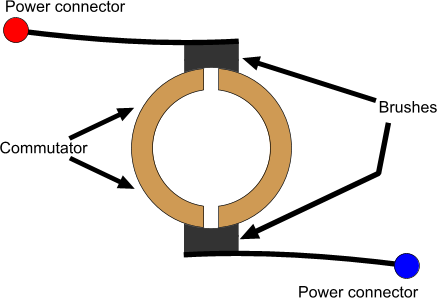
Commutators are mostly applied in direct current machines such as dynamos or as they are called DC generators and many DC motors as well as universal motors. By reversing the current direction in the rotating windings each half turn, a steady rotating force which is called torque is produced. In a generator the commutator picks off the current generated in the windings, reversing the direction of the current with each half turn, serving as a mechanical rectifier to convert the alternating current from the windings to unidirectional direct current in the external load circuit.
Brushless DC motors also need a commutation process, but the difference is that for brushless designs the commutation process is carried out electronically, via an encoder or hall effect sensors monitoring the position of the rotor to determine when and how to energize the coils in the armature.